
June 2026 Newsletter
The Gifts of Returning Home

Beyond the Titles We Wear
I returned to Japan for two and a half weeks in the second half of May.
The main reason for this visit was to attend the first memorial service for my cousin, who passed away suddenly last year. But I was also glad to be back during my favourite season of the year, when the fresh greenery is at its most beautiful. I took the opportunity to breathe in the fresh forest air in Kiyosato, Yamanashi Prefecture, and to go jogging along a riverside close to Moto-Hakone, watching the soft colours of the evening sky.
I found myself appreciating the simple gift of spending time alone in nature in Japan.
Like many of my visits home, the trip was busy and seemed to pass in the blink of an eye. And yet, this time, something was different.
For the first time, I felt I was standing on Japanese soil as an independent practitioner and founder of Synergy Facilitation, Chizu Matsushita. There was no longer the identity of being an employee of an international organisation, and I was also about to leave behind my identity as a university lecturer. I was simply myself, no longer defined by any particular job title.
Meeting people who have supported me over the years, as well as others whose work I deeply admire, gave me precious time to think about the kinds of collaborations I hope to build in the future.
The trip brought not only the excitement and freedom of imagining what I aspire to do now and in the future, but also moments of sadness, frustration and helplessness—particularly during my visit to Fukushima as I wrote below.
Yet the feeling I experienced throughout this trip was what I can only describe as being inspired—a word that is difficult to express in Japanese. I came away energised, uplifted, and with a deep sense of encouragement.

What I Received in Fukushima
The photograph above was taken with Ruiko Muto in Futaba Town, Fukushima Prefecture.
I first learned about Ruiko in late 2020, while preparing to organise an online event to mark the tenth anniversary of the Fukushima nuclear disaster. Ayumi Fukakusa from Friends of the Earth Japan, whom I had also invited to speak at the event, introduced me to Ruiko.
I immediately ordered Ruiko's books and began watching videos of her talks online. One speech in particular almost shocked me—the address she gave at the "Goodbye to Nuclear Power" rally on 19 September 2011, six months after the disaster. I also read the transcript of her speech published at the beginning of her book, From Fukushima to You.
I still remember the goosebumps. My immediate reaction was simply,
"How could I not have known about this person until now?"
There was certainly surprise, but also a sense of regret.
What struck me even more, however, was something else.
Although she was speaking about the difficult and deeply divisive issue of nuclear power, her words were filled with profound remorse for what had been left to future generations, grief for what had happened and what had been lost, a deep commitment to human connection, and gratitude for the compassion shown to Fukushima by people both within Japan and around the world.
Since then, I have had the privilege of inviting Ruiko to speak at two online events that I organised—one in 2021 and another last year.
During my first visit back to Japan after the pandemic in the summer of 2022, I met Ruiko in person for the first time. At the Tokyo District Court, I attended the gathering before the hearing, observed the court proceedings, and joined the reporting session afterwards for a lawsuit involving Fukushima evacuees who were being required to leave the temporary housing they had been provided after the disaster. It gave me the opportunity to witness one aspect of Ruiko's work at close hand.
Four years after that, I was finally able to visit the areas affected by the Fukushima nuclear disaster. That became possible because Ruiko kindly invited me after I told her I hoped to see her again. Together with her husband, Mr Sato, she generously spent the day showing me around Hamadori, where the scars of the disaster remain visible; the Fukushima Great East Japan Earthquake and Nuclear Disaster Memorial Park, located close to the nuclear power plant; and part of the Fukushima Innovation Coast Framework.
They also welcomed me to the place where Ruiko now works. It was a privilege to hear her calm, gentle voice again and to spend time with her. Yet throughout the day I couldn't shake the feeling that a cloud was hanging over my heart.
From the rooftop of the memorial park, we looked out across the vast Pacific Ocean. Behind us stretched beautiful green forests. Turning south, I could see the chimneys of the nuclear power plant where the accident had occurred.
At the end of the day I travelled from Funehiki Station in Tamura City to Koriyama, where I boarded the Shinkansen.
It was dusk.
The evening sun fell across the platform. Rice fields stretched beyond the train windows. Fresh green trees lined the landscape. The beauty of the Japanese countryside was right there before my eyes.
And yet this same landscape continues to live under the invisible threat of radiation. It is no longer possible simply to immerse ourselves in this natural beauty with complete peace of mind.
That thought stayed with me as I watched the scenery pass by from the train window.
When I arrived in Tokyo Station to change trains, I was suddenly surrounded by crowds of international tourists, commuters and people hurrying about their everyday lives.
For some reason, it felt strangely unreal.
There are places where time still seems to have stopped.
There are signs of rebuilding and hopes for the future.
And yet, life there also remains suspended in ways that are difficult to describe.
Leaving that behind, I watched the rest of the world continue to move forward.
That was the feeling I carried home from Fukushima.
Japanese and English subtitles are now available for the videos from the 2021 and 2025 online events, particularly Ruiko Muto's presentations. I hope you'll take a look.

What Nature Reminds Us
While I was in Japan, I also completed the in-person component of the Shinrin-Yoku (Forest Bathing) Facilitator training programme that I had begun online in April. That was the reason for my trip to Kiyosato.
It was during our family trip to France three summers ago that I was acutely reminded of the power of forest bathing.
While my daughter and partner were enjoying a treetop adventure course, I waited among the trees, watching them from below and taking photographs.
Then something unexpected happened. For reasons I couldn't explain, I was suddenly filled with a sense of energy that went far beyond simply feeling relaxed or refreshed.
I was genuinely astonished.
This may sound like an exaggeration, but it felt as though every cell in my body had been renewed, as if I had been given new life.
I hadn't gone into the forest expecting any particular benefit. In fact, the idea of forest bathing itself was little more than a vague memory of something I had heard about years before.
I remember thinking,
"Why do I feel like this...? Ah... this is Shinrin-Yoku!"
That was the moment I experienced its power for myself.
As a coach, I have always been interested in wellbeing, healing, and the many ways people can restore themselves. That experience led me to explore more deeply the value of spending time in nature. Since then, I have been reading about forest bathing, awe experiences, the relationship between Japanese people and nature, Shinto, and even Japan's Jomon period.
As I mentioned in my previous newsletter, I have recently begun incorporating sensory forest bathing into workshops for organisations and groups. I use it as a way of helping people reconnect with their values and remember what truly matters to them.
Going forward, I also hope to offer forest bathing experiences in natural settings as part of my work.
Just before returning to Japan, I created new business cards in both Japanese and English. Compared with my previous cards, they focus much more clearly on the kinds of challenges and situations I support people and organisations with, and how I go about that work.
After returning to the Netherlands, I also refreshed the wording on parts of my website.
Looking back, I don't think those ideas would have emerged without the time I spent in Japan. It became an opportunity to pause, reconnect with my own values, and reflect on the direction of my work.
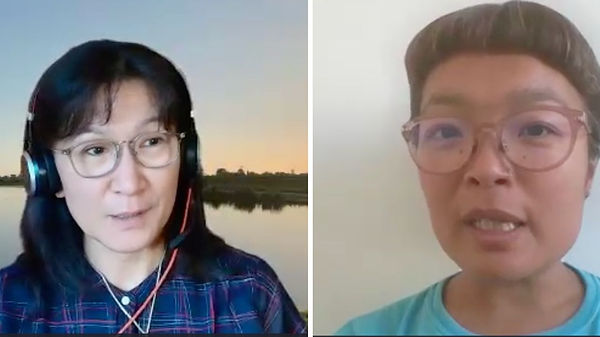
A Video Conversation on Coaching
I recently published my video conversation with Natsuno Shinagawa, who is both a coaching client and a friend.
In our conversation, she shares her thoughts on questions such as:
-
What led her to try coaching with me in the first place
-
What she feels coaching has brought to her life
-
How coaching differs from therapy
-
Her experience of working with me as a coach
-
Her thoughts on AI coaching
She also talks about her own journey and the work she has been involved in over the years.
The conversation is in Japanese, but I have added both Japanese and English subtitles, so I hope those who can only understand English will also enjoy watching it.
And if any of my English-speaking clients would be interested in recording a similar conversation with me, I'd love to hear from you.
It would be a pleasure to have a conversation with you!
You can watch the video here.